


Autumn Wines
After the longest, hottest, driest summer in history, I think we were all desperate for autumn to arrive with some rain, cooler weather and, finally, the desire to drink red wine again. If I need to put bottles of red into the fridge to get them to a decent temperature, I know there’s a problem.
Of course, the harvests were weeks, even a month early, and many were finished before they usually start. In August! What will they taste like, who knows? Doubtless the marketing machines will leap into action about ‘surprising results’ and ‘decent acidities’ but I wonder. For those who prefer lower alcohols and higher acidities, it’s not looking optimistic.
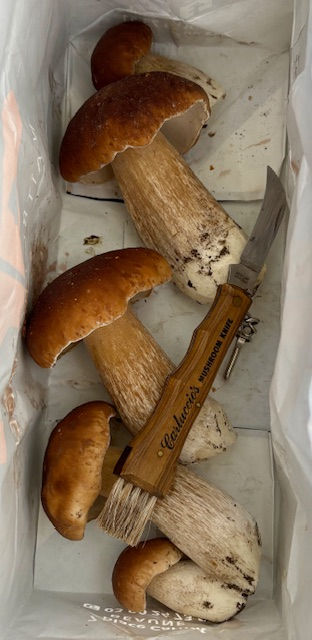
For sure the effects on another of my favourite pastimes were drastic. Normally the season for finding cepes/porcini starts sometime in September and runs through October, so lasts for a good month to six weeks. Sometimes it starts at the end of August or early September and is done by mid-October. Occasionally it runs into the first days of November. But this year the forest looked like a desert with trees poking out until mid-October and I didn’t see anything edible until the 20th – the inverse of the wine harvest, it only started after it had usually finished. And now, in early November, I guess it’s too cold, so a two-week season.
Not a great vintage for wild mushrooms either.
The endless vicissitudes of the climate.
But at least the quality of the mushrooms was excellent, perhaps as the ground was basically so dry that all the other competing animals of the forest (worms, slugs, beetles) couldn’t get to their favourite autumnal treat. I guess we should be content with small mercies.
But what to drink with such parsimonious and precious Natural bounty? We started with Burgundy, but all it did was further my frustration with the current state of the retail market. There is so much hype, hysteria and social media noise that you’d think that Pinot Noir was the sole red grape worth drinking for serious connoisseurs. As such the prices have reached levels that frankly make Burgundy largely a waste of money unless you are disinterested by value for money or totally obsessed with the right label.

Clos St Jacques is named after the Camino de Santiago de Compostela as after reaching the final destination cathedral, the pilgrims would go to the beach to find a scallop shell as a memento and proof of arrival. In French a scallop is a coquille St Jacques and Gevrey is on one of the pilgrim routes south. The walled vineyard is the greatest premier cru in Gevrey and served after some of the lesser grand crus by the likes of Rousseau, winemaker extraordinaire of the village. But this 2009 from Sylvie Esmonin was so reductive as to be undrinkable and had not budged the next day. In modern terms that’s 200 euros down the sink. I wouldn’t even cook with it.
A 2009 Morey St Denis 1e Clos de la Bussiere from the Chambolle megastar Roumier was also disappointing. It may sit close to Chambolle, but it’s not Chambolle, and it’s not even a great climat of Morey. Even in the greatest hands it’s going to retain a certain rusticity. Usually I quite like it, but this was, for whatever reason, just not up to scratch and as the label says Roumier, that’s an even more painful waste of money. We did at least drink most of it.
With our Norwegian friends I opened a couple of 2005 grand crus from Camille Giroud. The Latricieres was dense, creamy and lovely, but the Clos Vougeot was again reductive. Not to the same extent as the Clos St Jacques, but enough to render it rigid, charmless and slightly bitter. We didn’t manage to finish it. I’m (sadly) used to a lot of reductive whites, which is all the rage nowadays with people I think mistaking the struck match style of reductive, oxygen-free winemaking for some sort of glorious Chardonnay minerality, but in reds it’s less common, but here were two over reductive reds in a row, and not exactly everyday wines either.

On the flip side, a 2006 Griottes-Chambertin from Ponsot was the real deal. He has the largest holding in the smallest Gevrey grand cru, which sits in a hollow sandwiched between Charmes and Chapelle Chambertin, across the road from none other than Clos de Beze. Hallowed territory. It’s not a big bruiser of a grand cru, and all the better for that. It’s delicate, perfumed and full of beautiful red fruit, as if someone indeed had poured a bit of Chambolle into their Gevrey. A masterclass in fine winemaking, but at around four hundred euros a bottle, I’m not sure I could bring myself to add the word good value to my praise.
I don’t really know what to do? In my irritation, I just sold a few bottles of Burgundy that I think are not worth half their current resale price, but if I continue to do that, I’ll have nothing left to drink! As it was, we fled to take refuge across the border in the foothills of the Alps, rolling vineyards on multi-oriented slopes riven by three valleys, undulating landscapes carpeted in the psychedelic scarlets and golds of autumnal Nebbiolo, Dolcetto and Barbera.
Barolo.

And if we were to drink a superstar label, let it be at the more humble, affordable end of the scale. Bartolo (or now Maria-Teresa) Mascarello’s Langhe Nebbiolo was spot on aged ten, one of the LNs that I think needs a decade, (my favourite being Rinaldi). If you want the really good value, easy drinking everyday style you can do no better than Trediberri and Margherita Otto, who make LNs that are impossible not to enjoy and cost a pittance in comparison. They are not wines to sit and ruminate over; they offer pure pleasure to be downed with a smile. Delicious and uncomplicated.

But with the first mushroom risotto, and suspecting that it might also be the last, I wanted something special, and who better than G. Rinaldi’s old school blend of Nebbiolo from three vineyards, (Ravera, Le Coste, Cannubi San Lorenzo), a lovely classic mixture of almonds, roses and red fruit, perfume and ripeness, and a perfect match for porcini risotto. Rinaldi’s Tre Tine sits very high up in the pantheon of top Barolos, and yet all be it expensive, you can find it for I guess 60% of the cost of the Ponsot, and Griotte does not sit at the top table in Burgundy. Indeed, Rinaldi is probably about the same price as Roumier’s Morey, but there is simply no competition between the quality of the terroir. It’s not difficult to guess why so many Burgundy lovers have drifted across the Alps in their buying preferences.
The third arrow in the quiver of autumnal reds has to be Syrah, and our Norwegian friends came up trumps with the Rhone star of biodynamics and single vineyard Hermitage – Michel Chapoutier. And if you think that the hill of Hermitage is only home to massive masculine brutes, think again, these two came in at 13 and 13.5%, the same as a light footed, ethereal Chambolle dancing across your palate.
It was in fact the English, centuries ago, who added the H to the famed knightly hermit Chevalier Gaspard de Sterimberg who returned home from the Albigensian Crusade in 1224 and decided to live in solitary peace on the granite slop above what is now called Tain l’Hermitage. He built a tiny stone chapel dedicated to St Christophe and may even have looked after some wines. Though vines predated him, his fame gave the hill (& wine) its moniker, and the best known wine used to be Hermitage la Chapelle. A hermit in French is ermite, but of course les Rosbifs couldn’t pronounce this sothey added the H.

Anyway, we had Ermitage Le Meal and Le Pavillon, 1997 and 1996. The patina of thirty years of age is soft and velvety, the flavours all melded and gentle, some tar, some cassis, some of that iron/blood for which the wine is so famous, but all sung rather than bellowed. The Meal was the softest and most elegant, the Pavillon showing perhaps some of the stern power of the hard granite Bessards climat, a little tighter, younger, bloodier and more potent. It’s the greater wine but I think I preferred the softer charms of Le Meal, but both showed just how elegant and delicious great Syrah can be with time.
But I’m talking red. I have to admit that the Marsanne grape and white (H)ermitage is just not my thing. It’s a wine of the south, built on sunshine, thickly opulent with yellow and tropical fruits, honeyed and ripe to the point of sweetness, with a finish that I often find hard and, at 14.5% a wine that out-blasts the reds. For me it just too powerful and over the top, cloying and lacking the spine of acidity that I cherish in whites from further north.

It was an interesting comparison to compare the 2006 Ermitage de l’Oree with the 2009 Bonneau du Martray Corton-Charlemagne. Price-wise they are both now in orbit and their scores too. In fact, this is a perfect example of why I find scoring wines so difficult and ultimately so pointless, pun intended. These two wines would, I guess, score pretty much the same, and very highly. But between the 4 of us, the Burgundy with its licorice-minty fruit, long citrus acidity and tooth-coating chalky extract disappeared in minutes whereas the golden Ermitage with its tsunami of ripe fruit overwhelmed both out taste buds and the bacalao, so much so that the four of us gave up after drinking about half of it. Yet they’d score the same, but we found one to be almost undrinkable after half a glass each. I totally see why some people would love it and I fully agree it’s an impressive wine with amazing aromatics, but I just don’t like it. Sorry, but I only love the reds.
But the biggest, and happiest surprise was a bottle with a wonderfully old-fashioned label that I knew nothing about except that I’d heard of its name for decades and knew that it was the one iconic wine of Portugal. If Spain had Vega Sicilia, Portugal had Barca Velha. But beyond that I’m embarrassed to admit that I knew nothing, not the grape variety, not the region, not the winery and (thank God) not the price.

So here is the potted history. It was founded in 1952 in the Douro by winemaker Fernando Nicolau de Almeida long before the region started making serious and costly red table wines rather than just port. It’s only made in the best vintages, and I think that amounts to just 21 bottlings in 74 years! As for the grape mix, it’s a classic Douro blend of Touriga Nacional, Touriga Franca, Tinta Roriz, (Tempranillo) and Tinto Cão, mainly from Quinta da Leda and high-altitude vineyards in the Douro Superior. That’s all I can tell you.
I’ve drunk very few Douro reds, and I find Port way too heavy. My experience of Portuguese wines when on holiday in Lisbon a few years ago was that the Dao and Barraida regions offered great value and good whites and reds from authentic local varieties.
Anyway, Andre handed over this dusty old bottle of 1983 with its 43 year old front and back labels held on by Sellotape. He hoped it would be ‘alright’ but just in case, I took something else out of the cellar if needed. I am again embarrassed to say that our expectations were not very high, so little did we know.
I presumed that anything that age needed a decant for sediment (of which there was little) and a breath of fresh air after being cooped up for that long under a small, black and rather manky looking cork. To be honest, the cork did not inspire much hope and was complicated to extract.
‘Does it smell ok? Is it still alive?’
I nodded. To be honest the nose didn’t leap out of the decanter, but there was nothing musty, vinegary or bad, so I guessed it was fine, and the colour was remarkable – a medium bright red with no sign of age. In fact, of all the reds above, this had the brightest and youngest colour.
Anyway, I didn’t even taste it but left it in the decanter whilst we attacked the two whites (Corton and Ermitage). Whites and bacalao finished, we finally turned our attention to our rather unknown curiosity.
I poured it out. Yes, that colour was just amazing. Not a wrinkle. And yes, it did have a nose, something soft and comforting and old. It’s difficult to describe adequately a wine that you have never tried before and of grape varieties that you hardly know. But it had perfume and waves of soft ripe red fruit, almost sweet but not so, layers of flavour and gentle elegance. It was quite simply delicious and if anything seemed to grow with air. Old wine can have a silkiness and a softness, a texture that you just don’t find in younger wines, as well as a taste and smell that slowly grows on you, like a crescendo that you don’t really notice until its playing fortissimo on your palate.
We were all speechless and, of course, reached for the inevitable phone to look up what exactly was this wine that so surprised us. Then I realised that we had what people on social media insist on calling a ‘unicorn’ in our glass (as if wine was some sort of trophy to hang on a wall). And that it costs around 800 or 900 euros.
Well, it was easily the best wine of the autumn. But it was also a special, almost unique moment when you drink something that stops you in your tracks and quietly demands your full attention and then unveils its full beauty like a peacock’s tail, a surprise that you could not imagine. And the best thing was exactly that – the fact that we ignorantly had no idea, rather than the usual fevered anticipation before opening one of those mega expensive labels you dream about and which are almost bound to disappoint, so high is the hype and expectation.
What a treat! Muito obrigado.
Postscript - ‘The Wine in My Glass’
Jasper Morris MW (Author of ‘Inside Burgundy’)
‘I don’t often come across wine writing that catches my imagination but Adrian Latimer’s book – recently recipient of a rave review in World of Fine Wine Magazine – has impressed me. Naturally I dipped into the Burgundy chapters first, he hits the tone perfectly. Plent of other great stuff from further afield as well. Even better, proceeds support the Vendanges Solidaires charity. An early Christmas present to yourself or a deserving wine lover?
Raymond Blake in ‘The World of Fine Wine’ (Author of ‘Breakfast in Burgundy’)
‘Refreshing candor bereft of rancor is the hallmark of The Wine in My Glass, written by an enthusiast with no connection to the wine trade other than as a committed customer over many decades…. Hardly a page passes without a crisp insight that reveals the sort of deep understanding that is only achieved after years of alert engagement… Burgundy warrants several chapters, but the one that should be compulsory reading—“A Pox Upon You”—tells an unflattering tale about the blight of premature oxidation and its baleful and ongoing consequences… Keen observations such as this leaven every chapter of The Wine in My Glass. We need more wine writing of this ilk: engaging and enthusiastic first, informed and knowledgeable second—the sort of book that should be read with a glass of wine to hand rather than a highlighter pen.’
Hermione Ireland, Managing Director Academie du Vin Library
‘Loving this wine memoir from Adrian Latimer. A must for those who love great stories and writing, albeit primarily about wine. And it’s all in a good cause. All profits go to the Vendanges Solidaires association which helps winemakers who are suffering due to extreme weather conditions…’
Margaret Rand (World of Fine Wine, Decanter, Editor Hugh Johnson Pocket Wine Book)
‘I’ve enjoyed this book very much, and if you enjoy non-ego-driven, intelligent wine writing, you might enjoy it too.’
Gerard Maguire, Owner of 64 Wine
‘I packed the book with my stuff and am now enroute to Porto. I’m a very slow reader but as I turned out the lights in my hotel I had read the entire book. A first for me in a day.It’s a wonderful read. I have travelled in many of your footsteps.’
After some encouragement and a fair few blog posts, I published (Sept 2025) a book about my travels in the wine world - the people, places and, of course, wines. I am not a professional, so everything I say is objective and unbiased (so I can criticise when other journalists do not dare to do so for instance) and any profits will go to the Vendanges Solidaires association which was set up in 2016 to help winemakers who are in trouble after suffering the extreme weather conditions (frost, hail, fire, flood etc) which sadly are becoming ever more frequent: www.vendangessolidaires.com.
The book ranges from California to Sicily, via Salta, Jujuy and Patagonia in Argentina, Valtellina, Piemonte and Tuscany in Italy, Madeira and of course all over France (Burgundy, Chablis, Sancerre, Beaujolais, Bordeaux, the Rhone).
If you have found any pleasure and/or interest in this blog, I think you might enjoy it, especially as it has been brilliantly illustrated by Arabella Langlands-Perry who managed to juggle bringing up two young kids, helping run Maceo/Willi’s Wine Bar in Paris and producing artwork with an abundance of both talent and wit. Brava.
‘The Wine in My Glass – Tales of Wines, Winemakers and Places’
Published by The Medlar Press Limited, Fishguard, Pembrokeshire, autumn 2025. www.medlarpress.com
Available from Medlar in UK, and/or from me in France or Willis Wine Bar in Paris, Athenaeum in Beaune, 64 Wine in Glasthule, Co. Dublin.
Price UK Pounds 26 from Medlar or 35 Euros. All profits to charity.
Arabella’s artwork is available from Restaurant Maceo/Willis Wine Bar in Paris.


Comments