


Chambolle Musigny and 2009 Burgundy

2009. After the record drought heatwave summer of 2003, 2009 was perhaps the start of the higher frequency of hot years, with, recently, 2018, 2019, 2020, 2022 and 2023. It gives riper fruit and thicker density, more punch and more alcohol. Some like it, personally I find it tends to gloss over the pure beauty of Pinot Noir. Nice, but tending towards the cloying and the heavy, and subsuming those elegant differential nuances between vineyards into a mouthful of sweet fruit.
You might note that I avoided saying ‘hides the transparency of the terroir’ because I find the words ‘transparent’ and ‘terroir’ are now almost a joke when it comes to describing Burgundy as they are so over-used. Oh, and I guess I should say that sunny vintages also ‘obscure minerality’ but that too is now a tired cliché.
But as at 17 years old the 2009s are now perfectly mature to drink, and as at the time you didn’t have to be an investment banker (or tech bro?) to afford some of the good stuff, it seemed a good excuse to dig into it a bit. And in doing so I came up with a few thoughts on Chambolle-Musigny and the three great factors that define any wine.
Terroir; Vintage and Producer. That’s pretty much it – what the weather did, where it did it, and what the winemaker (and vine grower) did in response.
But in what order of importance would you rank them? Which is numero uno?
Of course I hear a chorus of ‘Terroir, you idiot!’. Yes sorry, how could I not genuflect at the altar of Burgundian terroir? It is, after all, mentioned in every article and every eulogy, a rather nice way of maintaining your everlasting monopoly of high quality if you happened to inherit (or buy) vines in the right place.
But I’m also sure that many would say ‘Producer, producer, producer’. Followed maybe by terroir and then vintage.
If you look at the market, that is the mantra. A lowly village terroir from Leroy, DRC, Dujac, Meo, Roumier, Mugnier, Rousseau (etc) would cost much more than a hallowed grand cru from a less reputed producer. Regardless of vintage. So, though the actual vineyard is a determinant in setting the price, the person who made it is the real key.
We recently had the rare joy of drinking three Chambolles from big names, all being 2009. And yes, the vintage was more or less imposing depending on the domaine, and the grandest of the vineyards was not at all the best (though here I admit that I trip up my logic as it was the most expensive by far, but then we stray into the area of cult vineyards).

So, let’s start with the most beautifully named vineyard in Burgundy, Les Amoureuses, and one of its larger and better-known makers, Groffier. (By the way, according to Chambolle superstar JF Mugnier, the name comes not from some charming story of lovers’ trysts, but of the clay that affectionately clings to your boots).
But if the reality is not as romantic as the nomenclature, the wine can (and should) be. As it sits next to Clos Vougeot downslope from Le Musigny, it sells for a fortune, so my experience is all too limited, but it can be perfumed, floral and sweetly red fruited, with above all a glorious texture, soft and silky. Not the iron fist of Musigny, but an elegance and sensual charm that is irresistible. Classic characteristics of what I think of as Chambolle, though I realise that the northern end by Bonnes Mares and bordering Morey-Saint-Denis is not like that, but then it’s not really considered to show the quintessential taste of Chambolle either?
The Groffier 2009 Les Amoureuses was indeed a big wine, dense, thick, spicey (from the oak?), quite sauvage and with sweet red fruit. Undoubtedly classy and if I was trying to guess it blind and be clever, I’d maybe punt for a Gevrey grand cru. I’d not guess Chambolle let alone Les Amoureuses. The elegance, the silk, the waft of flowerbeds was not there. It was a big, sunny wine. Very good but to be honest not my idea of what it might be and certainly not worth anywhere near its cult vineyard price nowadays. The remaining two bottles I have will go to auction.
The next wine was down the scale at village level, but up to the producer summit with Mugnier. Same vintage. He is reputed to make the most ethereal, delicate versions of the village. As for his 2009, it did not of course have the same weight, but the florality was there, the texture was gently creamy, the fruit red and only slightly sweet, and in many ways it seemed to have aged more gracefully (I don’t like wines when the animal, gamey taste begins to dominate). It was very Chambolle, and much less 2009. Lovely.

As an aside, we also had his 2011 of late. On the market it sells for a good deal less than 2009 as it’s a light vintage and some think its marked by pyrazines as was 2004, and claim that swarms of ladybirds (crushed with the grapes) were the cause. I do remember seeing a lot of them at harvest time, but though I do find many 2004s have a nasty green chemical taste that ruins the wine, I’ve not found it in 2011. Mugnier’s village was delicate, gentle and just so pretty – yes, it needs drinking now (but 15 years is not bad for a village wine from an off year, is it?!). I know the 2009 is technically better, but I think in many ways I preferred the 2011. If you want to taste the pure essence of the village, 2011 may be quieter, but actually sings better in tune than 2009.
Oh, and whilst on asides, Mugnier’s Nuits Saint Georges Clos de la Marechale 1e cru 2009 comes from a walled vineyard at the very southern tip of the village, a long way from the central hot spot of Les Saint Georges/Vaucrains/Les Cailles and even further from Vosne-Romanee. Not really the best place to be, but, again, Mugnier’s take on NSG and on 2009 has nothing rustic about it at all. Licorice, clove, dark fruit and creamy.

But back to 2009. Last night we had Ghislaine Barthod’s 1e cru Les Beaux Bruns. I vaguely recall a tasting with her and her husband 15 years ago and as Chambolle has always been pricey, I bought just two bottles. Oh, miserable fool! What would I do to have more of it now? I guess it’s closer to 250 euros these days, so out of my league, alas.
Anyway, the wine? Well, let’s go back to that blind tasting idea and the rather optimistic hope that I might be clever. I’d guess Les Amoureuses. It had everything I’d like from Chambolle – a glorious perfumed floral and red fruited bouquet, a soft, seamless body of red fruit that had all melded together over time, a gentle orange acidity and cedary undertow on the finish, maybe a hint of powdery tannins. A sweet core and that beautiful silky texture. Just beautiful.
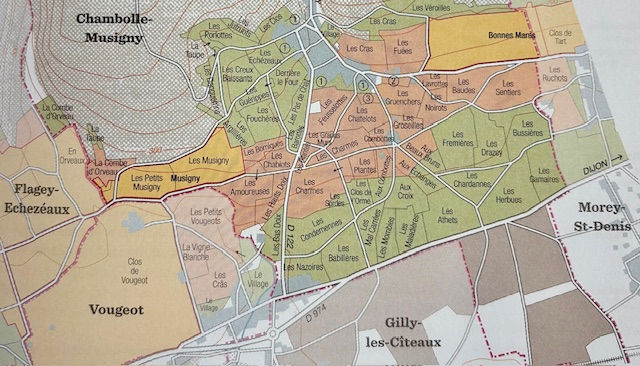
But where is Aux Beaux Bruns? In fact, it’s a bit in the middle of nowhere, not close to Musigny and at the bottom of the 1e cru slope. Not really hallowed terroir I’m afraid. Jasper Morris mentions that it’s from old vines that are grown north-south (not the normal east-west ie up/down the hillside) and it does look geographically like it’s at the bottom of the alluvial fan that flowed down from the Combe (valley) that splits the village. Perhaps that helps explain it’s quality? Or was it just that female touch?
Yes, yes, Producer, producer, PRODUCER!
Postscript - ‘The Wine in My Glass’
‘Loving this wine memoir from Adrian Latimer. A must for those who love great stories and writing, albeit primarily about wine. And it’s all in a good cause. All profits go to the Vendanges Solidaires association which helps winemakers who are suffering due to extreme weather conditions…’
Hermione Ireland, Managing Director Academie du Vin Library
After some encouragement and a fair few blog posts, I published (Sept 2025) a book about my travels in the wine world - the people, places and, of course, wines. I am not a professional, so everything I say is objective and unbiased (so I can criticise when other journalists do not dare to do so for instance) and any profits will go to the Vendanges Solidaires association which was set up in 2016 to help winemakers who are in trouble after suffering the extreme weather conditions (frost, hail, fire, flood etc) which sadly are becoming ever more frequent: www.vendangessolidaires.com.
The book ranges from California to Sicily, via Salta, Jujuy and Patagonia in Argentina, Valtellina, Piemonte and Tuscany in Italy, Madeira and of course all over France (Burgundy, Chablis, Sancerre, Beaujolais, Bordeaux, the Rhone).
If you have found any pleasure and/or interest in this blog, I think you might enjoy it, especially as it has been brilliantly illustrated by Arabella Langlands-Perry who managed to juggle bringing up two young kids, helping run Maceo/Willi’s Wine Bar in Paris and producing artwork with an abundance of both talent and wit. Brava.
‘The Wine in My Glass – Tales of Wines, Winemakers and Places’
Published by The Medlar Press Limited, Fishguard, Pembrokeshire, autumn 2025. www.medlarpress.com
Available from Medlar in UK, and/or from me in France or Willis Wine Bar in Paris.
Price UK Pounds 26 from Medlar or 35 Euros. All profits to charity.


Comments