


The Best of RIoja, Harvest Time in Logrono
Updated: Nov 5, 2025
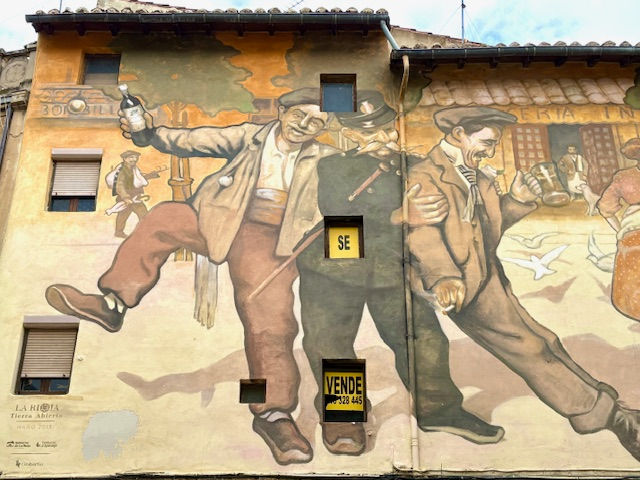
Street Mural in Haro, Rioja
It really was a fluke coincidence. My wife and cousins had been walking part of the Camino and I’d been chasing truchas in the Pyrenees and we met in Logrono. On the 20th September, date of La Fiesta de San Mateo otherwise called the Rioja Wine Harvest Festival.

Logrono La Fiesta
Now the Spaniards, or Riojans, know how to party. It kicks off with rockets, brass band marches, foot stamping of grapes and general mayhem at midday and continues for a week. There were at least four bands stomping round town, several stages set up with DJs or live bands, and people everywhere sporting their crimson Saint Matthew scarves.

Traditional harvest dress
It was a stark and happy contrast to France, an even bigger wine producing country that is regimented, controlled and all fun killed by the puritanical anti-drinking laws of the Loi Evin nowadays espoused by every so-called medical guru of health and grandstanding politician.
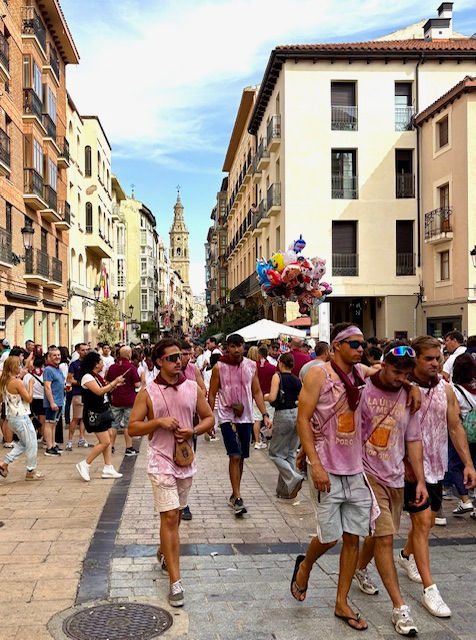
Wine soaked revellers
Logrono was a joyous sea of infectious bonhomie, music and wine spattered kids, the narrow streets echoing with the sound of music, singing, dancing and throwing wine. Everyone wore the scarf and white T shirts which were soon in deteriorating condition depending upon your age, the youngest in shreds and hosed pink with wine, clutching their bota de vino (wineskin) which is obviously very difficult to pour accurately anywhere near your mouth.
It was as if the whole of Spanish youth was in Logrono having fun. I saw a lot of beer and sangria, but no bad behaviour, though it was not exactly green. It seems that once you’ve finished your plastic cup of whatever, you chuck it on the floor and then grab a plastic take away dish which ends up likewise. There is so much wine on the pavement that your shoes begin to stick to it and an aroma of wine-drenched cotton pervades the city.
To keep the place under control, an army of 10 cleaning trucks and dozens of yellow jacketed cleaners circulates. They have their job cut out for them. It’s the only negative, apart from doubtlessly the odd headache the next morning and loss of voice. Well, and the bullfights…

The garbage army
The brass band was still thumping and hooting away at 9pm even after the Logrono skyline gave us its own firework display with electric streaks of lightning and a generous downpour. We cowered under inefficiently small umbrellas and headed for Sabores, and a sophisticatedly delicious tasting menu for a derisory 50 euros, washed down with an 12 year old traditional oxidative white from Relevo, Valcuerna (nutty, waxy, gently honeyed with refreshing acidity), and new wave (no American oak) tight herbal red from Telmo Rodriguez at Remelluri, both very affordable as Spanish restaurant marks ups are often less than the retail price. Hurrah. You don’t need to spend a fortune to taste the best of Rioja.
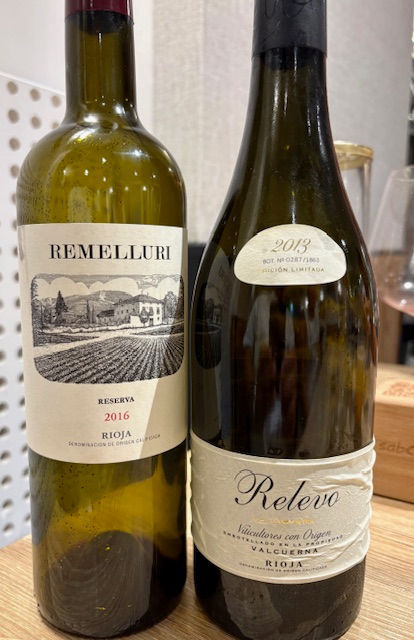
Good local wines for dinner
But the wine region is not just famous for its wine. Twenty minutes from Logrono stands Ysios, strikingly impressive and beautifully fitting within the equally monumental scenery. It floats like waves under the mountain range.

Ysios and its beautiful architecture
Further on you have the most iconic architecture (by Frank Gehry) at the Marques de Riscal hotel.

Hotel Riscal
It’s certainly noticeable with its wildly colourful roof, but for me is more in conflict with the scenery and the lovely old soft stone town behind it (Elciego) than in harmony, much more of a look at me statement. I’ve enjoyed many of their wines over the years and they age super well, but I found it highly commercial and when I saw their top wine Baron de Chirel at a great price but at 15.5%, it made the choice of whether to buy or not very simple.
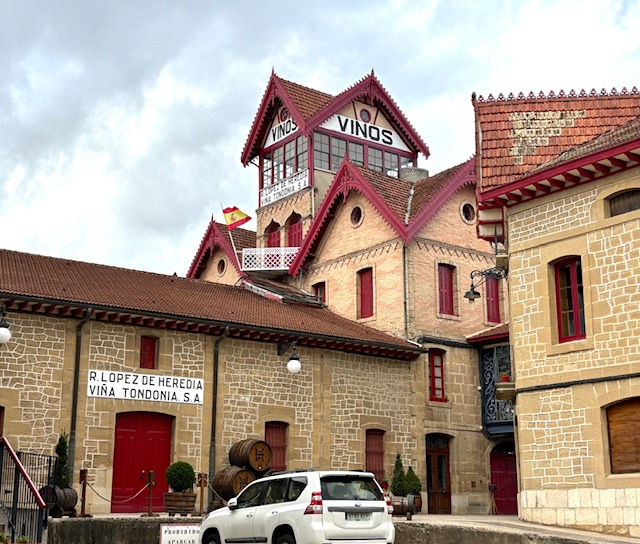
Lopez de Heredia, old school Rioja
Driving into Haro, the ‘capital’ of Rioja, two of the traditional superstars faced each other across the street, Lopez de Heredia, famed for the longevity of its reds and characteristically oxidative whites and La Rioja Alta, historically I think the most prized wines in the region. At their wine bar I tasted the 904 grand réserva cuvee from 1997, a bricky tawnied colour, a nose of roasted nuts and very sauvage, underpinned by a rounded ripe softness. With some air it reminded me more of matured Pinot than Tempranillo, perhaps a little drier but in the same vein, all about the glorious aromatics. We’d had the 2015 already, a wine that is redolent of brambly ripe dark fruit, with none of those Rioja charred vanilla oak overtones, but I’d say a good 5 years too young to show at its best. I picked one up to see (I might also add that happily the wineries also seem to sell at a decent discount to retail, which is often not the case back home).

A taste of 1997
It was only a (too) short weekend, no time to explore the rugged rolling landscape of the three Rioja regions or taste the differences between the traditional and the new, between heavily toasted American oak and a desire for purer wines, with organics and single vineyards, more wines of ‘terroir’ than blends. Between the freshness of modern Viura grapes - clean, crisp whites and the age-worthy weight of the old school with their bright deep colours and burnished flavour.
On the wines heavy dark clusters of blue-black grapes awaited their fate.

Rioja grapes ready for the harvest
Before leaving, opposite our hotel was an excellent wine shop (Baco enoteca) run by a man who’d worked at Artadi, an organic terroirist of the highest order. I wish I could have tasted and bought more, but I did pick up a nice little collection of the old and the new, all I think forming the top tier of Rioja.

A great Rioja line up
Postscript - ‘The Wine in My Glass’
After some encouragement and a fair few blog posts, I have published (Sept 2025) a book about my travels in the wine world, people, places and, of course, wines. I am not a professional, so everything I say is objective and unbiased (so I can criticise when other journalists do not dare to do so for instance) and any profits will go to the Vendanges Solidaires association which was set up in 2016 to help winemakers who are in trouble after suffering the extreme weather conditions (frost, hail, fire, flood etc) which sadly are becoming ever more frequent: www.vendangessolidaires.com.
The book ranges from California to Sicily, via Salta, Jujuy and Patagonia in Argentina, Valtellina, Piemonte and Tuscany in Italy, Madeira and of course all over France (Burgundy, Chablis, Sancerre, Beaujolais, Bordeaux, the Rhone). I'm interested in teh people, places and stories behind the wines we all love, not tasting notes and scores.
If you have found any pleasure and/or interest in this blog, I think you might enjoy it, especially as it has been brilliantly illustrated by Arabella Langlands-Perry who managed to juggle bringing up two young kids, helping run Maceo/Willi’s Wine Bar in Paris and producing artwork with an abundance of both talent and wit. Brava.
‘The Wine in My Glass – Tales of Wines, Winemakers and Places’
Published by The Medlar Press Limited, Fishguard, Pembrokeshire, autumn 2025. www.medlarpress.com
Available from Medlar in UK, and/or from me in France and Willis Wine Bar in Paris.


Comments